FocusOn Neurology
  • Gastrointestinal Resource Center
  • Highlights from ACG2024 - Focus on Ulcerative Colitis
  • Highlights from ACG2024 - Focus On Fatty Liver Disease
  • Inflammatory Bowel Disease
  • NASH Resource Center
  • Highlights from DDW 2025
  • Highlights from ACG 2025 - Focus on Ulcerative Colitis
  • Highlights from ACG 2025 - Focus on Metabolic Dysfunction–Associated Steatohepatitis (MASH)
  • Primary Biliary Cholangitis Knowledge Hub
  • C. difficile & Microbiome Therapeutics Knowledge Hub
  • Highlights from DDW 2026
  • Gastrointestinal Resource Center
  • Highlights from ACG2024 - Focus on Ulcerative Colitis
  • Highlights from ACG2024 - Focus On Fatty Liver Disease
  • Inflammatory Bowel Disease
  • NASH Resource Center
  • Highlights from DDW 2025
  • Highlights from ACG 2025 - Focus on Ulcerative Colitis
  • Highlights from ACG 2025 - Focus on Metabolic Dysfunction–Associated Steatohepatitis (MASH)
  • Primary Biliary Cholangitis Knowledge Hub
  • C. difficile & Microbiome Therapeutics Knowledge Hub
  • Highlights from DDW 2026

Advanced Search

Advanced Search

  • Featured:
  • Primary Biliary Cholangitis Knowledge Hub
  • C. difficile & Microbiome Therapeutics Knowledge Hub
  • Highlights from DDW 2026

Comparative Safety of Potassium-Competitive Acid Blockers on the Risk of Clostridioides difficile Infection: A Multicenter Cohort Study

March 2026
Share:
Back to C. difficile & Microbiome Therapeutics Knowledge Hub Peer-reviewed articles

Read Full Article

INTRODUCTION: 

Proton pump inhibitors (PPIs) have been associated with an increased risk of Clostridioides difficile infection (CDI) in previous observational studies. However, real-world evidence on the CDI risk of potassium-competitive acid blockers (P-CABs), a newer class of acid suppressive agents, remains limited.

METHODS: 

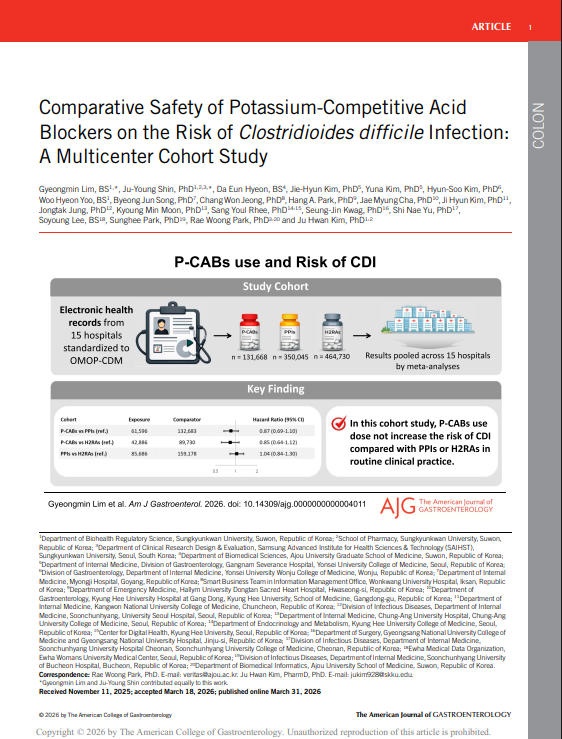
We conducted a retrospective cohort study using electronic health record data from 15 hospitals standardized to the Observational Medical Outcomes Partnership Common Data Model and integrated through Federated E-Health Big Data for Evidence Renovation Network. Patients newly prescribed P-CABs, proton pump inhibitors (PPIs), or histamine 2 receptor antagonists (H2RAs) were included and the primary outcome was the occurrence of CDI. After 1:4 propensity score matching, pairwise comparisons were conducted using Cox proportional hazards models. Hazard ratios (HRs) and 95% confidence intervals (CIs) were then pooled across databases by meta-analysis.

RESULTS: 

In the 1:4 matched cohorts, we identified 61,596 P-CAB users (mean follow-up, 72.6 ± 29.9 days) and 132,683 PPI users (74.9 ± 28.6 days), 42,794 P-CAB users (69.5 ± 32.4 days) and 89,415 H2RA users (69.9 ± 33.1 days), and 85,686 PPI users (71.1 ± 31.2 days) and 159,178 H2RA users (68.0 ± 33.8 days) across the 3 pairwise comparisons. The pooled HRs were 0.87 (95% CI, 0.69–1.10) for P-CABs vs PPIs, 0.85 (0.64–1.12) for P-CABs vs H2RAs, and 1.13 (0.98–1.29) for PPIs vs H2RAs. Results were generally consistent across subgroup and sensitivity analyses.

DISCUSSION: 

In this cohort study, P-CAB use was not associated with a higher risk of CDI compared with PPIs or H2RAs.

Share

Modal body text goes here.

FocusOn logo
  • Articles
  • Multimedia
  • Blog
  • Resources
  • About FocusOn
  • Privacy Policy
  • Terms of Use

© 2026 Wolters Kluwer. All right reserved.

Your Privacy

To give you the best possible experience we use cookies and similar technologies. We use data collected through these technologies for various purposes, including to enhance website functionality, remember your preferences, show the most relevant content, and show the most useful ads. You can select your preferences by clicking the link. For more information, please review our Privacy and Cookie Policy.

|
|

Cookie Policy

Information about our use of cookies

Wolters Kluwer ("we" or "us") wants to inform you about the ways we process your personal information. In this Privacy & Cookie Notice we explain what personal information we collect, use and disclose.

Personal information means any data relating to an individual who can be identified, directly or indirectly, based on that information. This may include information such as names, contact details, (online) identification data, online identifiers, or other characteristics specific to that individual.

Read More